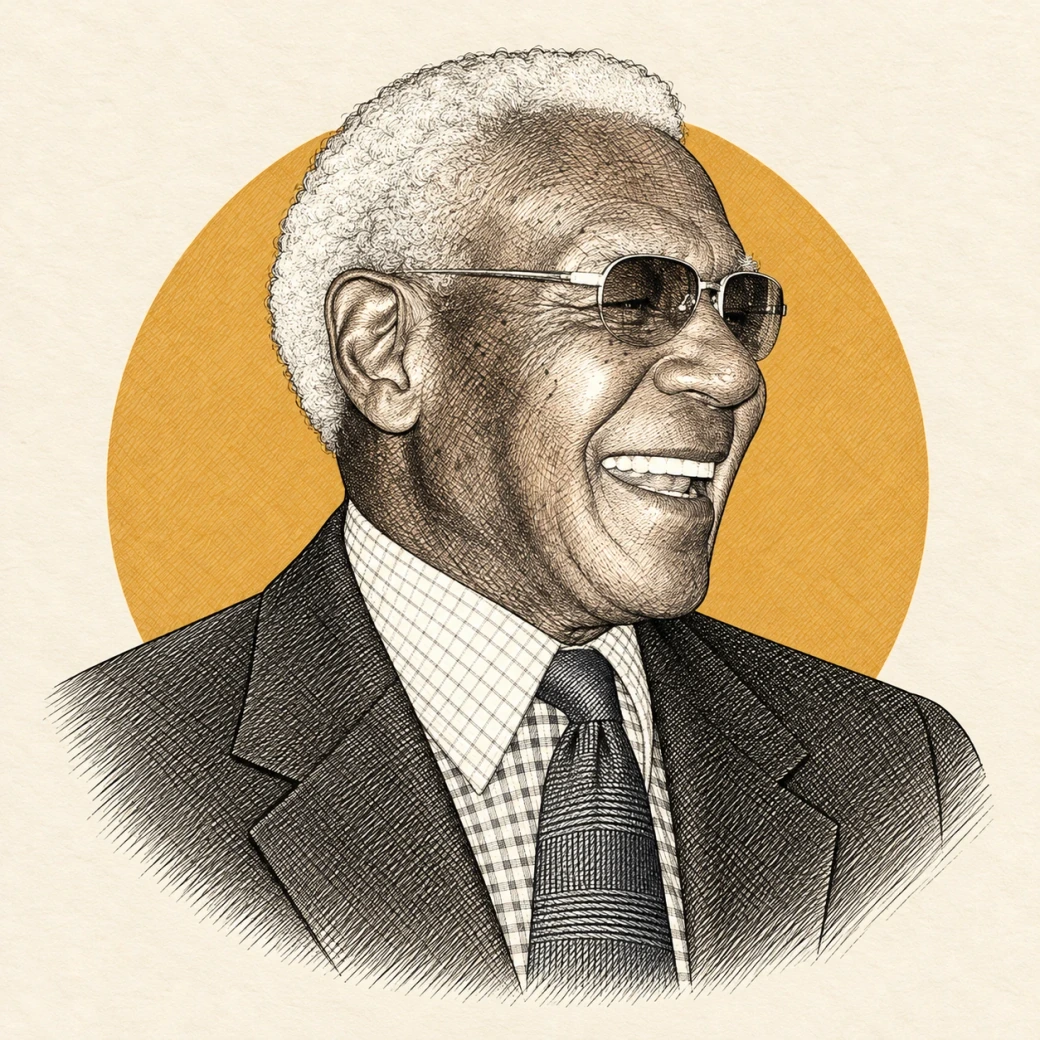
When Ernie Banks was inducted into the National Baseball Hall of Fame, the man he credited most was not a big-league manager but the coach who had signed him out of the Negro Leagues. “I patterned my life after Buck O’Neil,” Banks told the Associated Press at O’Neil’s funeral in 2006. “Buck was a role model for my life. He was the greatest ambassador for the game.”
John Jordan O’Neil was born on November 13, 1911, in Carrabelle, Florida, and grew up in Sarasota. The grandson of an enslaved man, he was barred from enrolling at Sarasota High School because he was Black, so he attended Edward Waters College in Jacksonville instead. He broke into professional baseball with the Memphis Red Sox of the Negro American League in 1937 and joined the Kansas City Monarchs at first base the next year. He would remain with the Monarchs for nearly two decades.
The teams he played for kept winning. From 1939 through 1942, Kansas City captured four consecutive Negro American League pennants, sweeping the Homestead Grays in the 1942 Negro League World Series. O’Neil left the team for Navy service in 1943, returned, and in 1946 won the Negro American League batting title with a .353 average. In 1948, the Monarchs named him player-manager, a role he held through 1955. He discovered and developed young talent along the way, including Banks and Elston Howard, who later became the first Black player for the New York Yankees.
In 1955, O’Neil signed on as a scout for the Chicago Cubs. He is credited with signing Hall of Famers Ernie Banks and Lou Brock to their first professional contracts, along with future major leaguers such as Oscar Gamble. In 1962, the Cubs promoted him to their major league coaching staff, making him the first Black coach to serve on an American or National League roster. He returned to scouting in 1964, signed future Hall of Famer Lee Smith, and in 1988 the Kansas City Royals brought him home as a scout.
Back in Kansas City, O’Neil took on the work that would define his final decades. The Negro Leagues had folded, and the records of the men who played in them were fading with them. In 1990, he helped establish the Negro Leagues Baseball Museum in the city’s 18th and Vine district and served as chairman of its board. “Sometimes, I think God may have kept me on this Earth for a long time so I could bear witness to the Negro Leagues,” he told the Kansas City Star.
In 2006, seventeen Negro Leagues players and executives were inducted into the Hall of Fame. O’Neil came to Cooperstown to speak on their behalf. “I’ve done a lot of things I really liked doing,” he told the crowd. “But I’d rather be right here, right now, representing the people who helped build a bridge across the chasm of prejudice.” Less than three months later, on October 6, 2006, he died in Kansas City at 94.
Recognition continued after his death. President George W. Bush awarded him the Presidential Medal of Freedom on December 7, 2006. In 2008, the Hall of Fame dedicated a statue of O’Neil and created the Buck O’Neil Lifetime Achievement Award in his name. In December 2021, the Hall’s Early Baseball Era Committee elected him to the Hall of Fame, and he was formally inducted with the Class of 2022. The museum he built in Kansas City remains open, still preserving the league whose players he spent a lifetime representing.