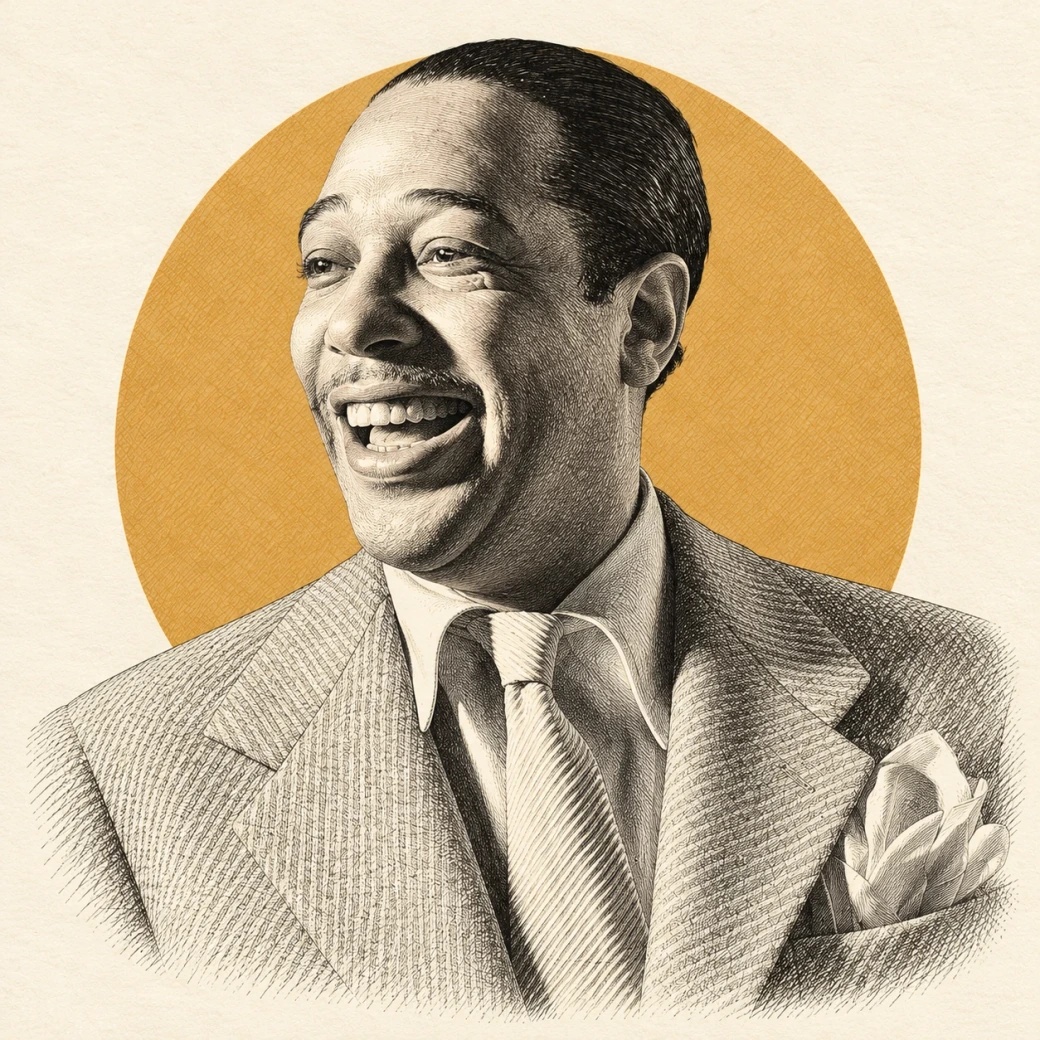
Edward Kennedy "Duke" Ellington was born in Washington, D.C., in 1899 and grew up in a Black middle-class family. His early interests included baseball and commercial art. Music teachers Henry L. Grant, Oliver "Doc" Perry and Louis Brown were part of his education. Before becoming an internationally known bandleader, he worked within a local musical community and organized the Duke's Serenaders.
In 1923, Ellington and fellow musicians moved to New York, where their group became known as the Washingtonians. A 1927 engagement at Harlem's Cotton Club brought national radio exposure through NBC broadcasts. He continued returning to Washington, including performances at the Howard Theatre. Those connections link his New York career to the city where his musical life began.
An essential partnership began when Ellington met Billy Strayhorn in December 1938. Strayhorn joined his organization the following month and became a composer and arranger closely associated with the orchestra. Strayhorn wrote "Take the 'A' Train," one of the ensemble's best-known pieces, a credit that belongs to him even though the orchestra made the song famous.
Their projects also reached the theater. *Jump for Joy* opened at Los Angeles's Mayan Theatre in July 1941, presenting African American talent in a musical revue. The Library of Congress's Strayhorn chronology records the production alongside compositions, performances and later travel. In 1963, the orchestra toured the Middle East and South Asia under State Department sponsorship, taking this collaborative music to audiences abroad.
Ellington's writing included extended works such as *Black, Brown and Beige*, *Such Sweet Thunder* and the *Far East Suite*. The musicians around him helped give the orchestra its character: bassist Jimmy Blanton and saxophonists Ben Webster and Paul Gonsalves feature prominently in the Pulitzer organization's account of his career. He also recorded *Money Jungle* in 1962 with bassist Charles Mingus and drummer Max Roach, working in the smaller setting of a trio.
Recognition arrived late from some institutions. A proposed Pulitzer special citation was not awarded in 1965. Ellington died in 1974, and the Pulitzer board honored him posthumously in 1999.