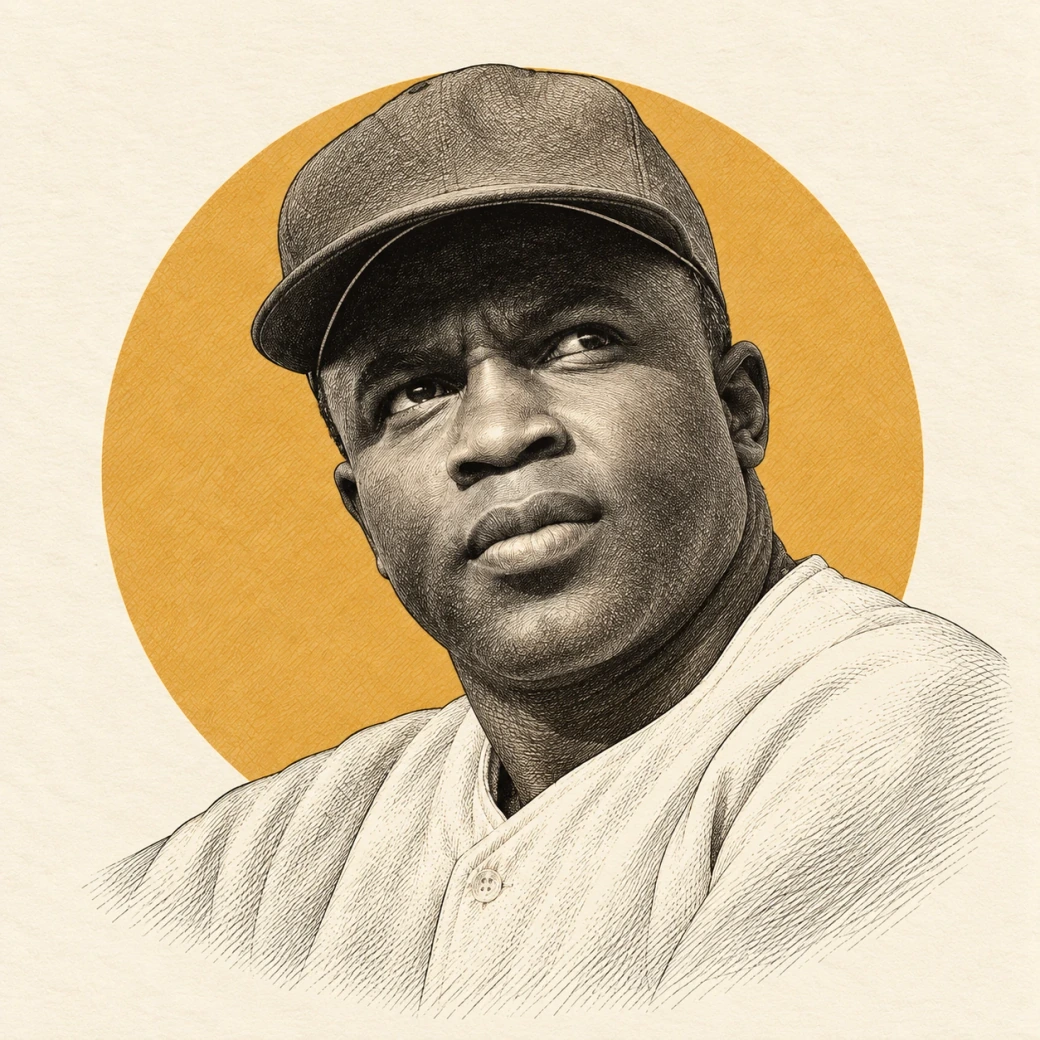
Jackie Robinson was born in Cairo, Georgia, in 1919 and grew up in Pasadena, California. He attended Pasadena Junior College and UCLA, where he competed in baseball, basketball, football and track. Drafted into the Army in 1942, he became a second lieutenant. In 1944, his refusal to move to the back of an Army bus led to a court-martial. He was acquitted and later received an honorable discharge.
On April 15, 1947, Robinson took the field for the Brooklyn Dodgers, breaking Major League Baseball's modern-era color barrier. Dodgers executive Branch Rickey had recruited him, and Robinson played for the Montreal Royals before joining Brooklyn. His arrival required confronting racist hostility as well as the demands of professional competition.
Robinson won Rookie of the Year in 1947 and the National League's Most Valuable Player award in 1949. In 1955, he helped Brooklyn win the World Series. His 1962 election to the Baseball Hall of Fame recognized a playing record that extended beyond the importance of his debut. The National Archives describes his ten-year major-league career as including six National League titles and one World Series victory.
After baseball, Robinson worked as an executive at Chock full o'Nuts and supported civil rights organizations, including NAACP fundraising and board service. In 1964, he co-founded Freedom National Bank in Harlem, extending his public work into institutions concerned with economic opportunity.
His advocacy also produced a substantial written record. The National Archives presents letters and telegrams involving Presidents Eisenhower, Kennedy and Johnson, as well as other White House correspondence spanning issues and administrations.
Robinson supported Martin Luther King Jr.'s civil rights work while disagreeing with his opposition to the Vietnam War. Stanford's King Institute documents that disagreement and Robinson's continued respect for King. After Robinson died in 1972, Rachel Robinson established the Jackie Robinson Foundation in 1973 with assistance from others, and its scholarship work continued under her leadership.