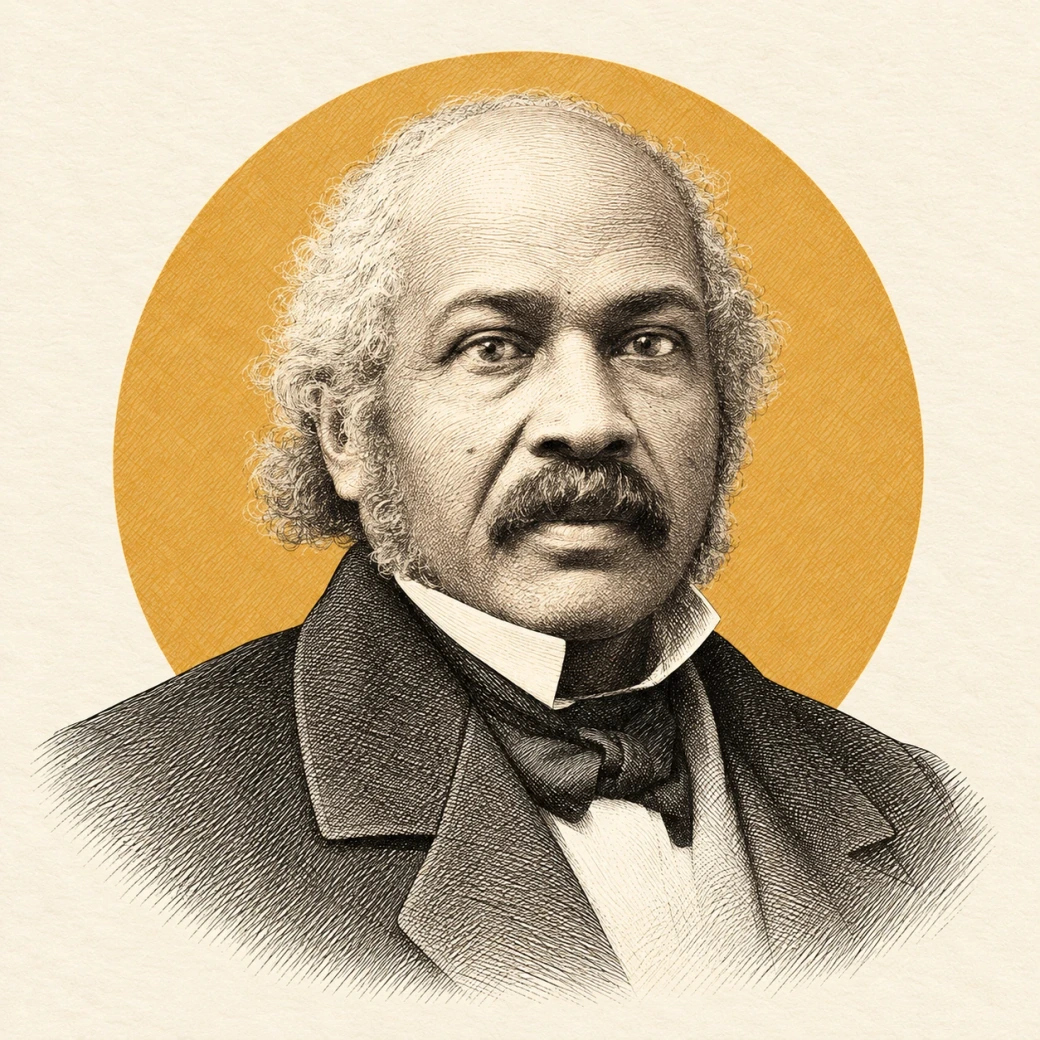
James McCune Smith opened his pharmacy on West Broadway in Manhattan in 1838. It was the first pharmacy in the United States run by an African American, and it became more than a place to fill prescriptions: Black activists met there to plan how to protect fugitives from slavery.
Smith had been born enslaved in New York City in 1813. He was freed under New York's emancipation law in 1827, and by the age of nine he was enrolled at the New York African Free School, the institution where many of the city's free Black children were educated. American colleges refused to admit him, so he sailed for Scotland. He spent 1832 to 1837 at the University of Glasgow, earning bachelor's, master's and medical degrees, and became the first Black American to hold a medical degree.
Denied admission to American medicine's schools, he came home in 1837 to a practice that served Black and white patients. From 1846, he was physician to the Colored Orphan Asylum on Fifth Avenue and 44th Street, caring for children there for nearly twenty years and giving them smallpox vaccinations against a disease that regularly swept through the city's crowded quarters.
His work as an abolitionist drew on his scientific education. Smith used statistics to challenge racist claims built on the 1840 census, which defenders of slavery cited as evidence of Black inferiority. He showed that the census's numbers did not support the argument, an early use of data analysis against scientific racism, and he argued that the census's race categories were social classifications rather than biological facts. He contributed to antislavery newspapers as well. In Frederick Douglass' Paper, his series The Heads of Colored People portrayed the lives of everyday Black workers, writing ordinary Black people into a literature that mostly ignored them.
Smith died in 1865, months before the end of the Civil War. In 2026, Amstat News, the magazine of the American Statistical Association, counted him among the pioneers who established statistics as a tool against racist claims. And in Glasgow, the university that granted the degrees American schools refused him now has a building that carries his name.
Sources and further reading
- The education and medical practice of Dr. James McCune Smith (1813-1865), first black American to hold a medical degree.
- America's First Black Physician Sought to Heal a Nation's Persistent Illness
- James McCune Smith | Amstat News
- James McCune Smith: An Outcast from the Land of the Free | Historic Environment Scotland
- James McCune Smith | American Academy of Arts and Sciences
- The First African American Physician | Searchable Museum, National Museum of African American History and Culture
- James McCune Smith | Wikipedia