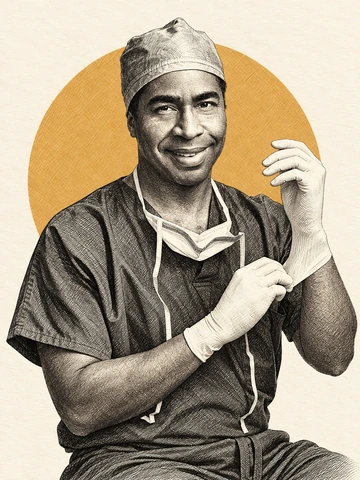
Keith L. Black was born in Tuskegee, Alabama, in 1957 and spent part of his childhood in Auburn before his family moved to Ohio. His parents were educators. As a teenager, he worked in a laboratory at Cleveland's St. Luke's Hospital with Frederick Cross and Richard Jones, whose research involved artificial heart valves. That experience led to an early scientific paper about red blood cells.
He entered an accelerated program at the University of Michigan that combined undergraduate and medical education. In a published interview, Black recalled becoming interested in neurosurgery after studying neuroanatomy. He subsequently completed medical training and joined UCLA's faculty in 1987. The account places classroom learning and laboratory experience alongside the later clinical career for which he became known.
Black moved to Cedars-Sinai in 1997 to lead its neurosurgical institute. BlackPast includes him among people in African American history and documents that move, along with the opening of a research center honoring Johnnie L. Cochran Jr. in 2007.
Cedars-Sinai's research profile lists work on the blood-brain barrier, targeted drug delivery, tumor immunology and imaging. These subjects concern how substances reach brain tissue and how brain tumors can be studied and treated.
Teaching younger students has been another part of Black's work. He founded Brainworks in 1998. A July 2023 Cedars-Sinai report describes the program as a daylong introduction to neurosurgery for local students. It also documents a meeting in which Black answered a high-school student's prepared questions about entering medicine. That exchange gives a concrete example of mentorship beyond a general statement of support.
In that report, Black explained that earlier mentors and programs had encouraged his own interest in medicine and that he wanted other students to encounter scientific careers. The hospital also described educational activities in simulated clinical rooms, where students could explore instruments and practice on lifelike models.