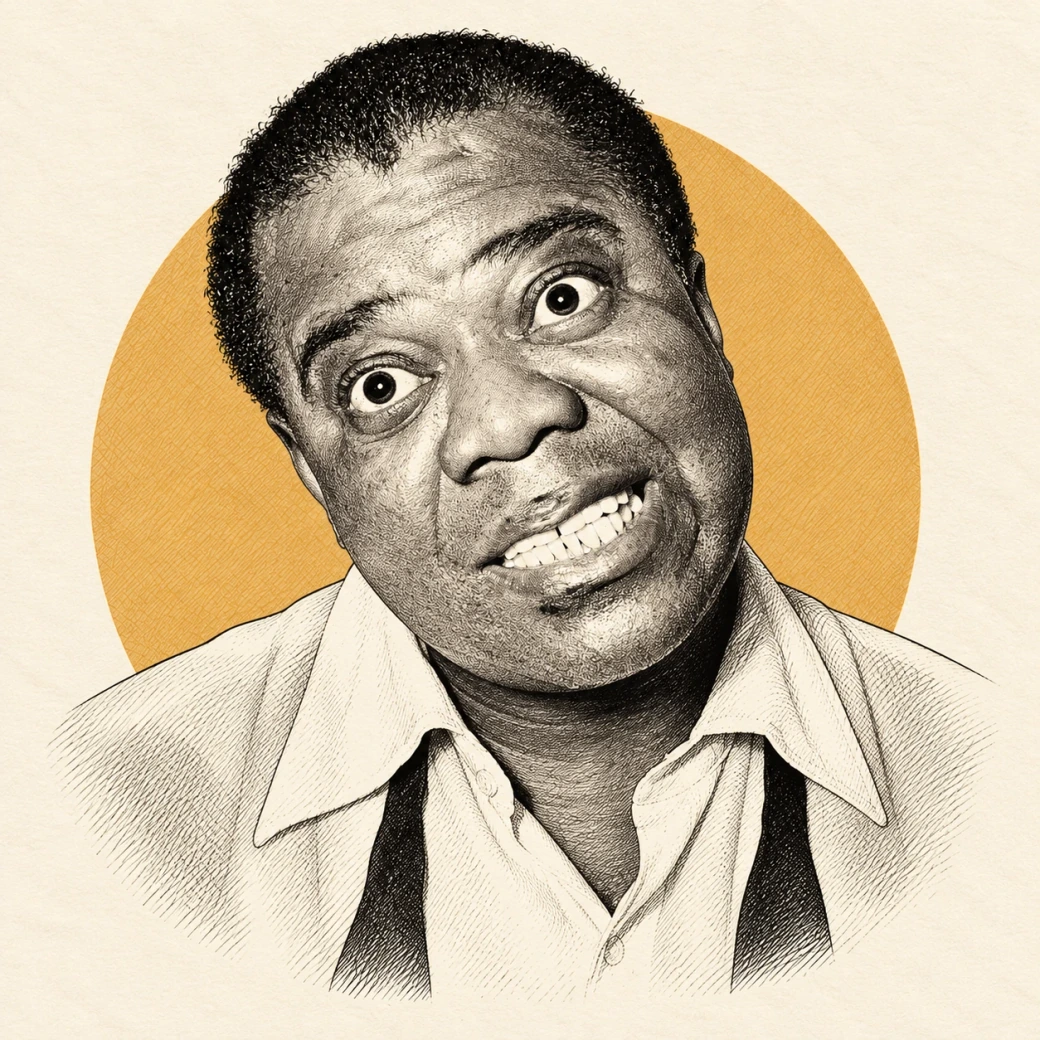
Louis Armstrong was born in New Orleans on August 4, 1901. On New Year's Eve 1912, he was arrested for firing a gun into the air and sent to the Colored Waif's Home for Boys, where bandleader Peter Davis taught him to play the cornet properly.
Cornetist Joe "King" Oliver became his mentor, and in 1922 Oliver sent for Armstrong to join his band in Chicago, where the two cornetists' intricate exchanges made the band the talk of the town. Armstrong then spent a year in New York with Fletcher Henderson and His Orchestra before returning to Chicago, where he began recording under his own name in 1925. The Hot Five and Hot Seven sessions that followed became his most influential recordings, performances that helped bring the improvised solo to the center of jazz. Pianist Lillian Hardin, whom he married in 1924, and the other ensemble members were part of that work. His June 28, 1928 recording of "West End Blues" with the Hot Five came to be regarded as a landmark of recorded jazz, three minutes that showed what an opening solo statement could do.
Armstrong's expressive singing and trumpet playing reached audiences through recordings, films and international tours. From 1947, when the popularity of big bands was fading, his small group, Louis Armstrong and His All Stars, became his principal performing ensemble, and he led it on stages around the world for the rest of his career. In 1957 he criticized the government's handling of the treatment of Black students during the Little Rock school integration crisis. In 1964 his recording of "Hello, Dolly!" reached number one on the Hot 100, ending a fourteen-week stretch in which the Beatles had held the top of the chart, a number-one hit more than four decades into his recording career. He died on July 6, 1971.