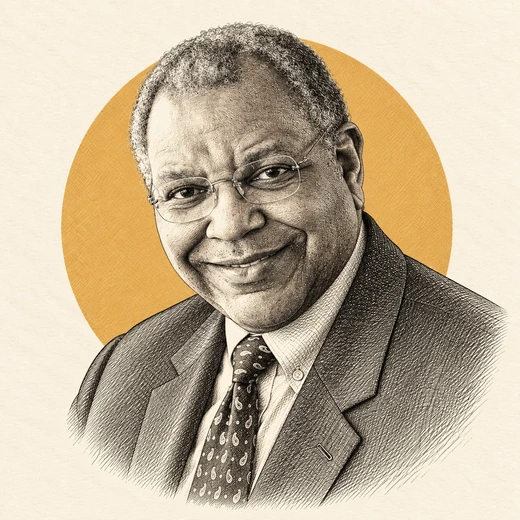
Otis Webb Brawley grew up in Detroit, where his mother worked as a hospital cashier and his father as a hospital janitor. He attended Catholic schools and later studied at the University of Chicago. BlackPast explicitly identifies him as the first African American to serve as the American Cancer Society's chief medical and scientific officer. His career has included research, clinical work and public discussion of health policy.
Johns Hopkins records his medical degree in 1985, internal-medicine residency in Cleveland completed in 1988, and medical-oncology fellowship at the National Cancer Institute completed in 1990. These stages spanned several institutions and preceded his later roles at Emory University, Grady Memorial Hospital and the American Cancer Society.
In a 2019 interview published by *The ASCO Post*, Brawley credited several mentors. John Altman encouraged his interest in oncology and the National Cancer Institute; Barry Kramer drew him toward cancer prevention and public health. Brawley described mentorship as something extending beyond one relationship, including encouragement to help more women and minority physicians enter the field.
From 2007 to 2018, he served as the American Cancer Society's chief medical and scientific officer. Reflecting on that period, he emphasized the process used to develop screening guidance and the need to examine research systematically.
His 2012 book, *How We Do Harm: A Doctor Breaks Ranks About Being Sick in America*, was written with Paul Goldberg. It examines both excessive medical intervention and barriers that prevent people from receiving care. The publisher's account and Brawley's interviews place the book within his wider criticism of how medical resources and incentives operate.
At Johns Hopkins, his roles include oncology research and community outreach focused on disparities in cancer care.