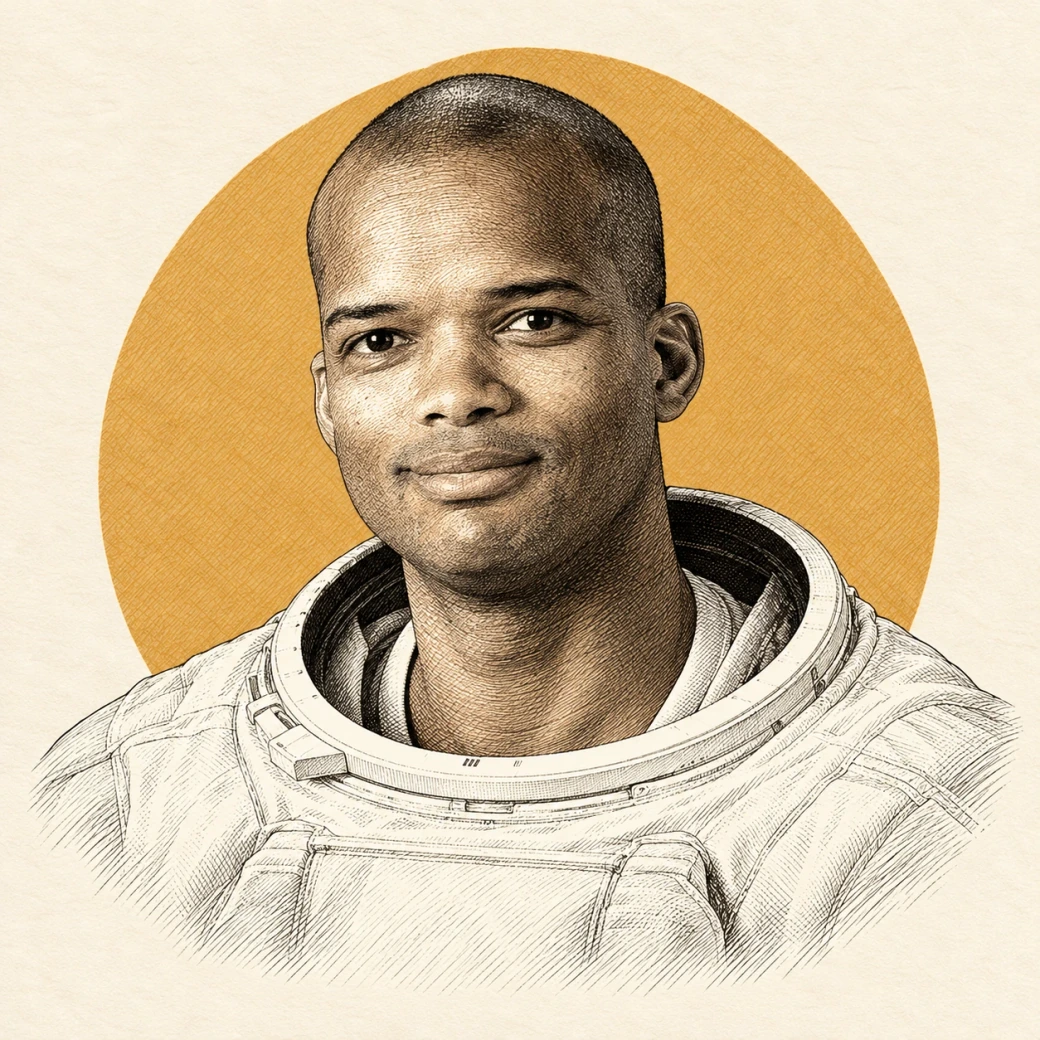
Robert L. Curbeam Jr. is a former NASA astronaut and retired U.S. Navy captain who flew three Space Shuttle missions. His flights included STS-85 in 1997, STS-98 in 2001 and STS-116 in 2006. He completed seven spacewalks totaling 45 hours and 34 minutes. His spacewalks helped assemble the International Space Station, from connecting its laboratory to rewiring its power system.
Curbeam earned an aerospace engineering degree at the U.S. Naval Academy in 1984. He later earned a master's in aeronautical engineering in 1990 and a degree in aeronautical and astronautical engineering in 1991 at the Naval Postgraduate School. As a naval flight officer, he served with Fighter Squadron 11 aboard USS Forrestal. His training included the Navy Fighter Weapons School and Test Pilot School. NASA selected him in December 1994. His agency duties later included spacecraft communications and safety leadership, alongside flight assignments.
During STS-98, Curbeam worked with Thomas Jones on three spacewalks as the crew installed the Destiny laboratory. Their tasks included connecting electrical, data and cooling lines, helping relocate a docking port and preparing equipment for later station assembly. While Curbeam attached a cooling line, ammonia crystals leaked onto his suit. The crew followed decontamination procedures before returning inside. Astronauts operating the shuttle's robotic arm and crew members inside the station supported the spacewalkers.
On STS-116, Curbeam completed four spacewalks, setting a record for a single shuttle mission. He installed the P5 truss with Christer Fuglesang and rewired power systems on later outings with Fuglesang and Sunita Williams. When a solar array would not retract fully, managers added a fourth outing. Curbeam and Fuglesang guided it into its storage box, supported by other crew members operating the station's robotic arm. That final spacewalk prepared the array for a later move.
Curbeam retired from the Navy and NASA in November 2007 and moved into private industry. In an October 2019 Challenger Center interview, he discussed his work as the organization's board chairman; he had joined its board in 2015. He described spacewalking as combining physical and mental skills and explained how training taught him to keep a specific task in view while watching for larger problems. He also emphasized learning from several mentors and described his efforts to interest young people in science and engineering.