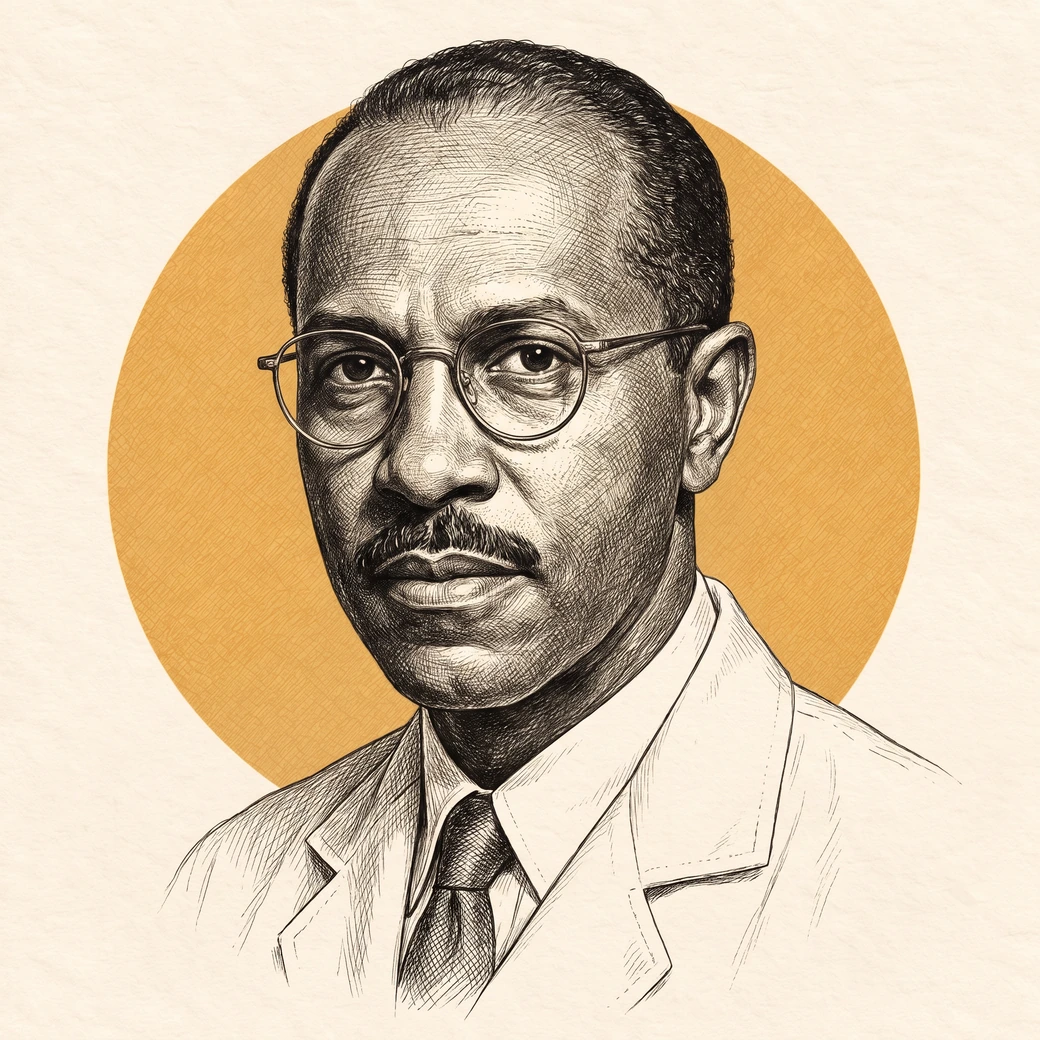
Vivien Theodore Thomas was born in Louisiana in 1910 and grew up in Nashville, Tennessee. He graduated from Pearl High School and hoped to pursue medicine. Historical accounts describe savings lost in a bank failure during the Depression, limiting his educational plans. In 1930, he began working with surgeon Alfred Blalock at Vanderbilt University.
The University of Virginia's medical-history collection explicitly identifies Thomas as African American. His work developed in institutions shaped by segregation, where the responsibilities he carried were not matched by the credentials or recognition usually associated with surgical research. He never earned a medical degree, but he became a highly experienced laboratory practitioner and teacher.
At Vanderbilt, Thomas and Blalock investigated traumatic shock. Thomas performed experiments and developed equipment, including a spring device that could apply different levels of pressure. The university's historical account describes their research connecting shock with loss of fluid and blood volume. This laboratory work formed an important part of their collaboration before the heart operation for which they are better known.
When Blalock moved to Johns Hopkins in 1941, Thomas accompanied him. Pediatrician Helen Taussig sought a surgical approach for children with a congenital heart condition associated with inadequate oxygen in the blood. Thomas helped develop and test a procedure in laboratory animals before it was used clinically. The work joined Taussig's clinical question, Blalock's surgical role and Thomas's experimental expertise.
In 1944, Thomas advised Blalock during the first operation on an infant using the approach. Vanderbilt's account describes his continuing work around subsequent operations as well as his management of laboratory research.
Thomas also trained surgeons in techniques required for heart and lung operations and supervised the Johns Hopkins surgical laboratories for decades. The institution's portrait biography records his mentorship of early African American medical students and acknowledges that racial prejudice delayed official recognition of his contribution.
Johns Hopkins awarded him an honorary Doctor of Laws in 1976 and appointed him to the medical-school faculty. The degree honored his work; it was not a medical qualification. His 1985 autobiography documented the research partnership, with correspondence and manuscript drafts preserved in the university's archives. He died that year.