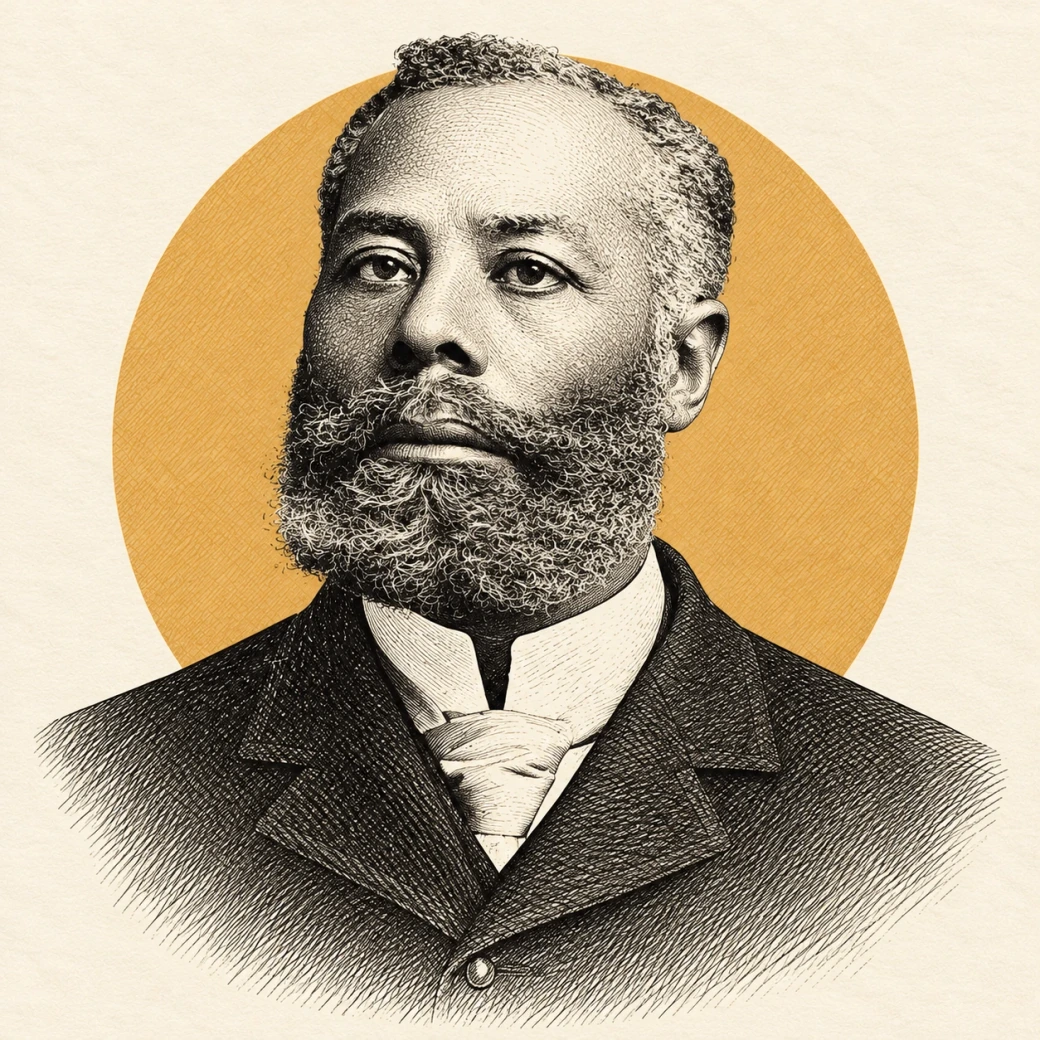
In the 1870s, a locomotive's engine had to be stopped before its moving parts could be oiled. On a railroad, every unnecessary stop cost time and money, and the firemen who tended locomotives spent much of their shift lubricating axles and bearings by hand. Elijah McCoy, a Black Canadian-born engineer working in Michigan, patented a better answer in 1872: an automatic lubricator, known as the oil-drip cup, that used steam pressure to pump oil to the parts that needed it while the engine kept running.
McCoy was born on May 2, 1844, in Colchester, Ontario, Canada. His parents, George and Mildred McCoy, had been born into slavery and fled Kentucky through the Underground Railroad. The family moved to Ypsilanti, Michigan, when Elijah was three years old. His parents recognized his mechanical talent and, when he was fifteen, sent him to school in Edinburgh, Scotland, to study mechanical engineering, where he qualified as a master mechanic and engineer.
Back in the United States, widespread discrimination prevented him from finding work as a mechanical engineer. He took a job with the Michigan Central Railroad as a fireman, shoveling coal into the furnace and oiling the engine's moving parts. That vantage point gave him the practical knowledge behind his first invention, and the railroad later promoted him to instructor, teaching others to use his patented technology.
The oil-drip cup became standard equipment on long-distance locomotives, and versions of his equipment were used on transatlantic ships and in factory machines. Because the design was simple and effective, other companies produced imitations, and buyers who wanted the reliable original asked for what historians believe gave rise to the phrase "the real McCoy." The saying's exact origin is uncertain, but it points to the reputation his equipment carried.
McCoy kept improving his designs and held more than 50 U.S. patents by the time of his death, most of them related to the railroad industry. He moved to Detroit in 1882 and worked as a consultant to the railroad industry. He died in 1929. In 2012, the U.S. Patent and Trademark Office named its first satellite office, in Detroit, after him.