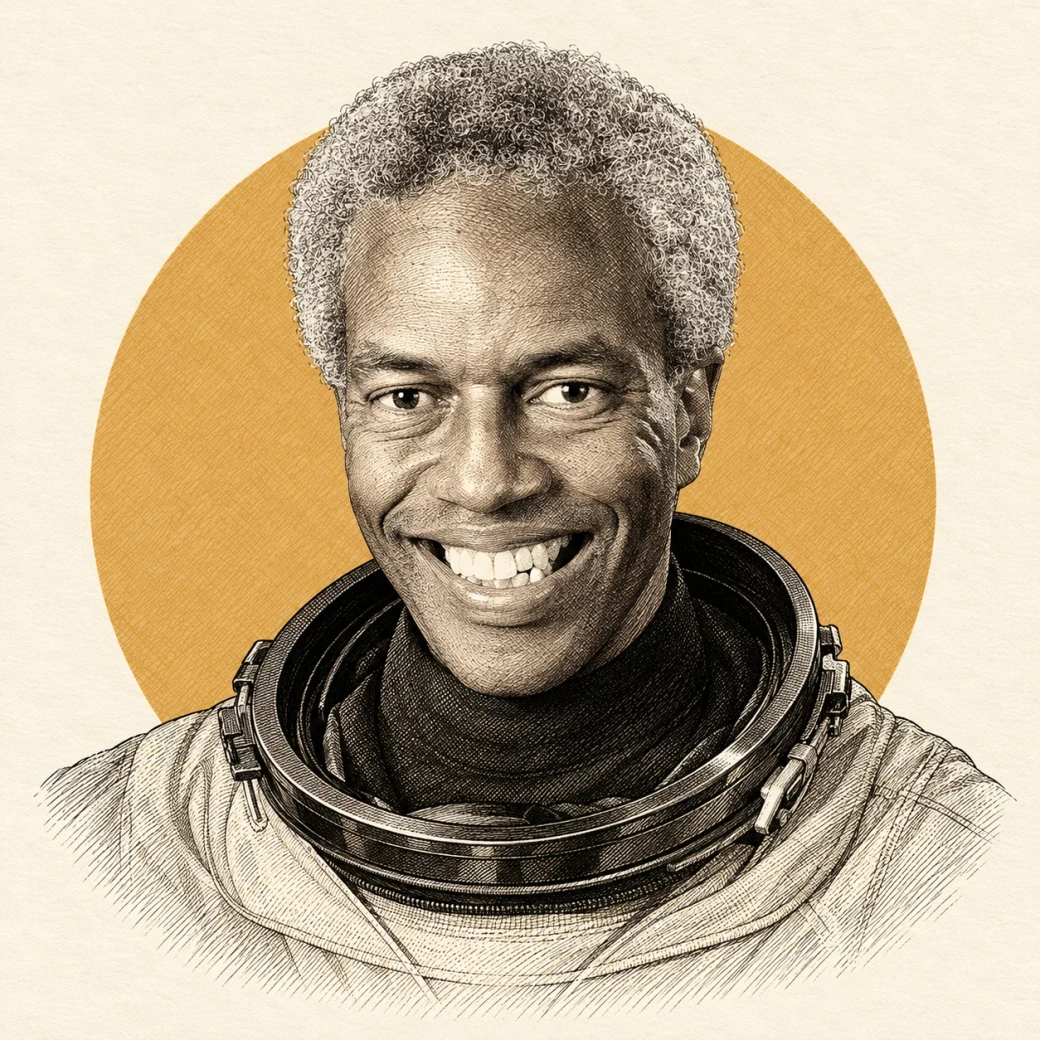
On August 30, 1983, the space shuttle Challenger lifted off on its eighth mission. Aboard was Guion S. Bluford Jr., a mission specialist who became the first African American to fly in space. The crew deployed a communications satellite for India and carried out experiments and tests of the shuttle's robotic arm across the flight.
Bluford was born in Philadelphia in 1942 and earned an aerospace engineering degree at Penn State before completing master's and doctoral degrees at the Air Force Institute of Technology. His Air Force career included flying, teaching pilots and research in flight dynamics, the study of how aircraft move through the air. NASA selected him as an astronaut candidate in 1978, in the class that was the agency's first to include women and minority astronauts.
Bluford served as a mission specialist on four shuttle flights, ending with STS-53 in 1992. Mission specialists handle experiments, payload operations and spacewalks, and his work also included payload safety and verification of flight software. He left NASA and retired from the Air Force in 1993, continuing his career in the aerospace industry.
His first flight came in the third year of shuttle operations, a program that would eventually fly 135 missions. Bluford's flights placed him in that record four times, and his engineering doctorate reflected the technical depth the astronaut corps drew on.
The 1978 class was drawn from a pool that had previously been almost entirely white male test pilots. The shuttle era had opened a different kind of flying, and mission specialists like Bluford handled the payloads and experiments that made each flight a working research platform.
Bluford earned his doctorate while serving as an Air Force officer, and his flight-dynamics research informed the shuttle's flying qualities. After NASA he held senior roles in the aerospace industry, and his four missions became a reference point for the engineers and pilots who followed him into the corps.
His missions came during the program's busiest years, when the shuttle carried station components, satellites and science payloads in rapid succession.