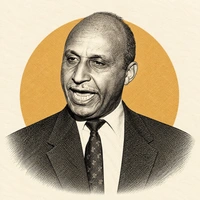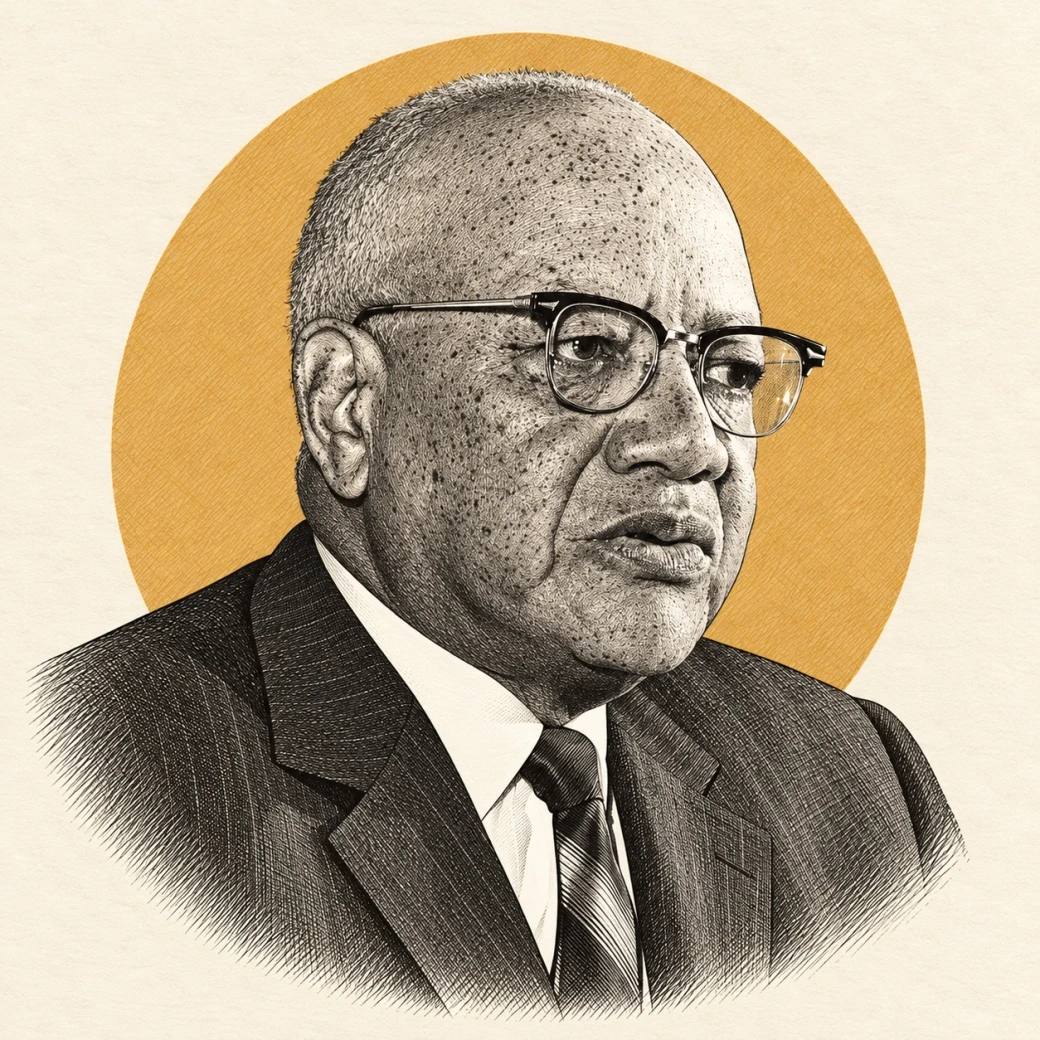
James Madison Nabrit Jr. was one of the lead lawyers in Bolling v. Sharpe, the Washington, D.C., companion case to Brown v. Board of Education, arguing it with George E. C. Hayes. The case was decided under the Fifth Amendment's Due Process Clause, and its 1954 outcome barred segregated public schools in the capital. "Let the Supreme Court take the blame if it dares to say to the entire world, Yes, democracy rests on a legalized caste system," Nabrit had written in 1952, as the case made its way upward.
Nabrit was born in Atlanta in 1900, the son of a Baptist minister. He graduated from Morehouse College in 1923 and received his law degree from Northwestern University in 1927, then practiced law in Houston beginning in 1930. In 1936, he joined Howard University's law faculty, and two years later he began teaching what historians describe as the first formal civil-rights course at an American law school.
Through the 1940s and early 1950s, he handled civil-rights cases for the NAACP Legal Defense and Educational Fund, working with Charles Hamilton Houston, Thurgood Marshall and others. He won voting-rights cases at the Supreme Court in Lane v. Wilson, on voter registration in Oklahoma, and Terry v. Adams, on the private primaries that excluded Black voters in Texas. In Bolling, he and Hayes lost in the district court and in the Supreme Court's 1952 and 1953 hearings before the Court ruled in their favor in May 1954. Contemporaries considered him one of the leading constitutional and civil-rights lawyers of his generation.
Nabrit led Howard's law school as dean from 1958 to 1960 and then became the university's second Black president, serving from 1960 to 1965. In 1966, he represented the United States as a deputy ambassador to the United Nations. He returned to Howard's presidency from 1968 to 1969. He died in Washington in 1997 at ninety-seven. His son, James M. Nabrit III, followed him into civil-rights law, and Howard's law school holds an annual lecture in his name.