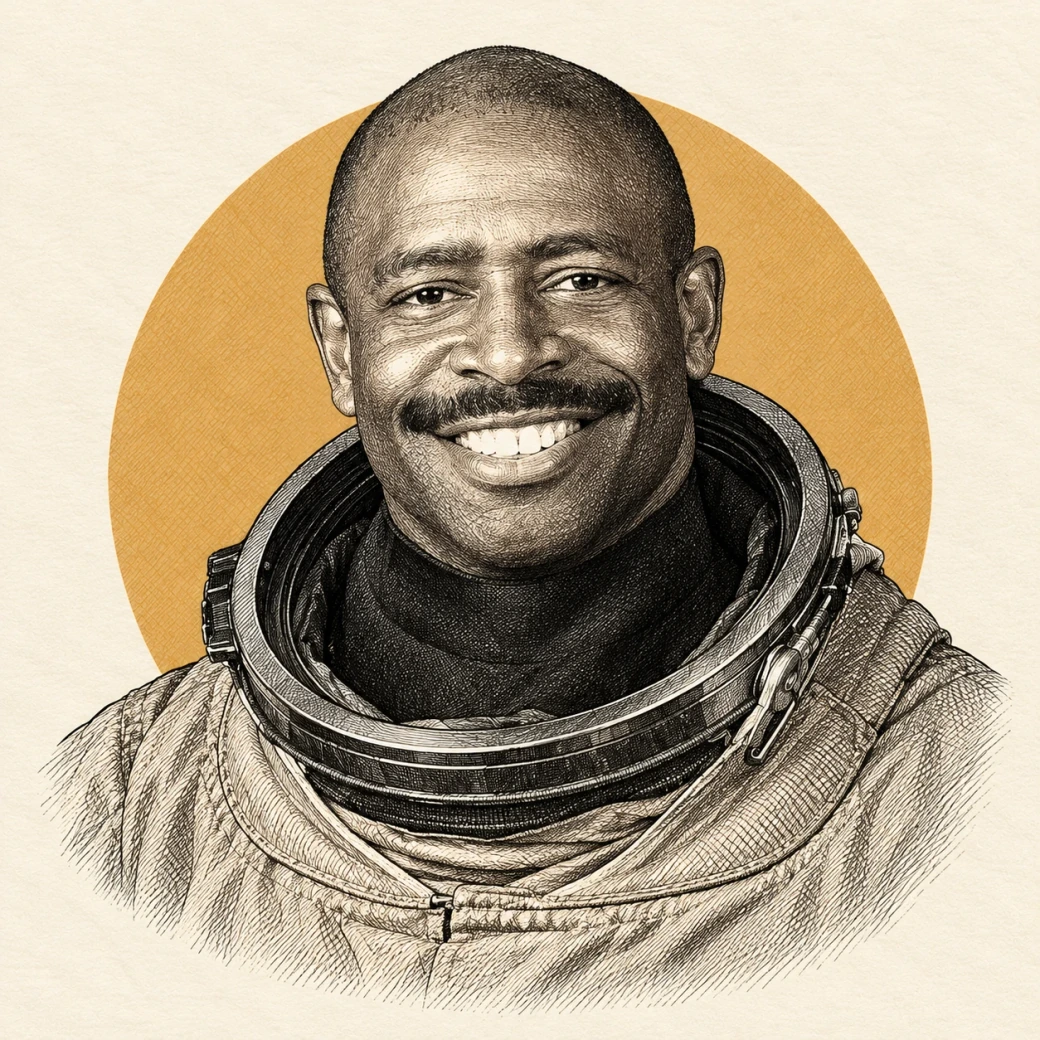
In February 2008, space shuttle Atlantis carried the European Space Agency's Columbus laboratory to the International Space Station. Crew members completed three spacewalks to prepare the laboratory for its scientific work. Aboard as a mission specialist was Leland D. Melvin, an engineer who had spent nearly two decades at NASA before he reached orbit. He returned to Atlantis in November 2009 on STS-129, a flight that delivered about 30,000 pounds of spare parts for the systems that provide power to the station, keep it from overheating and maintain its orientation in space. Across the two missions, he logged more than 565 hours in space.
Melvin was born on February 15, 1964, in Lynchburg, Virginia. A football scholarship took him to the University of Richmond, where he played wide receiver from 1982 to 1985 and became the school's all-time reception leader, an Associated Press All-America selection in 1984 and 1985. He earned his chemistry degree in 1986, and the Detroit Lions selected him in the eleventh round of the 1986 NFL draft. A hamstring injury followed within months and he was unable to fully recover. He also took part in the Toronto Argonauts and Dallas Cowboys training camps before his playing career ended.
The injury redirected him toward engineering. In 1989, he joined the Fiber Optic Sensors group of the Nondestructive Evaluation Sciences Branch at NASA's Langley Research Center, using optical fiber sensors to measure strain, temperature and chemical damage in composite and metallic aircraft structures. In 1994, he was chosen to lead the Vehicle Health Monitoring team for the X-33, a cooperative Lockheed/NASA program to develop a reusable launch vehicle. His team built distributed fiber optic strain, temperature and hydrogen sensors to monitor the health of the vehicle's composite liquid oxygen tank and its cryogenic insulation. In 1996, he codesigned an optical facility that could produce in-line fiber optic Bragg grating strain sensors at rates above 1,000 per hour.
His path to orbit nearly ended during training. In NASA's Neutral Buoyancy Laboratory, a six-million-gallon pool where astronauts rehearse spacewalks underwater, a training accident damaged his hearing, and tests revealed severe hearing loss in both ears. He was moved to earthbound assignments while doctors worked to identify the cause. Melvin stayed with the space program, and once his hearing improved he returned to full flight status.
NASA had selected him as an astronaut in 1998. Before his flights, he served as co-manager of the Educator Astronaut Program, traveling across the country to involve thousands of students and teachers in space exploration.
In October 2010, NASA Administrator Charles Bolden named Melvin associate administrator for education, responsible for the development and implementation of the agency's education programs. In that role he served on the White House National Science and Technology Council's committee on STEM education and represented the United States on the International Space Education Board. He retired from NASA in February 2014 and has continued his involvement with science education and corporate boards, including BWX Technologies, Inc.