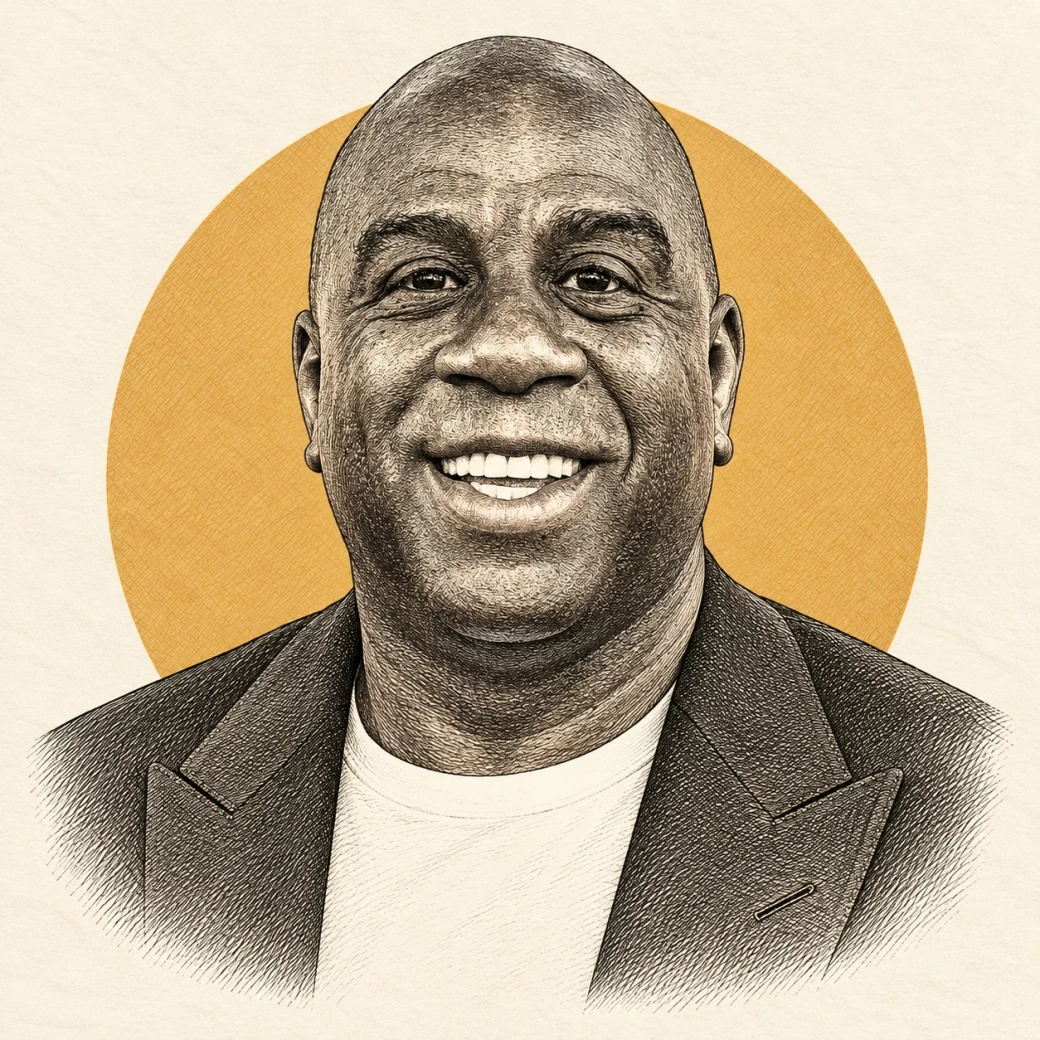
Earvin "Magic" Johnson helped the Los Angeles Lakers win five NBA championships and earned three league Most Valuable Player awards. At six feet nine inches, he played point guard, directing an offense associated with the team's Showtime era. His passing and ability to play several positions became central to the Lakers' success. He later built a business career through Magic Johnson Enterprises, investing with partners in retail, entertainment, financial services and professional sports.
Johnson grew up in Lansing, Michigan, and played at Everett High School before attending Michigan State. The Spartans won the 1979 NCAA championship with Johnson in the lineup. That year, the Lakers selected him first in the NBA Draft. As a rookie, he helped Los Angeles win the 1980 championship and became Finals MVP. His subsequent Lakers titles came in 1982, 1985, 1987 and 1988, during a career that included twelve All-Star selections and four seasons leading the league in assists.
In 1991, Johnson announced he had HIV and retired from basketball. He played in the 1992 All-Star Game and returned to the Lakers in 1996. He was also a member of the U.S. team that won Olympic basketball gold in Barcelona in 1992. The Basketball Hall of Fame inducted him as a player in 2002.
Johnson's businesses included movie theaters developed with Sony Pictures and a partnership with Starbucks that began in 1998. Those ventures served customers in urban neighborhoods, extending his work beyond endorsements into operating partnerships. He later sold his Starbucks interest. His investment activity also expanded into financial services through EquiTrust and food service and facilities management through SodexoMAGIC. Magic Johnson Enterprises describes its focus as providing products and services for diverse communities, a business strategy Johnson pursued through several kinds of companies.
Sports ownership became another part of that work. Johnson joined partnerships owning the Los Angeles Dodgers, Los Angeles Sparks and Los Angeles Football Club. In 2023, he became part of the group that acquired the Washington Commanders; the ownership group bought the professional football franchise for $6.05 billion. His work with Loop Capital also extended into infrastructure investment. A 2026 Wake Forest University profile identifies projects involving airport terminals at John F. Kennedy and LaGuardia.