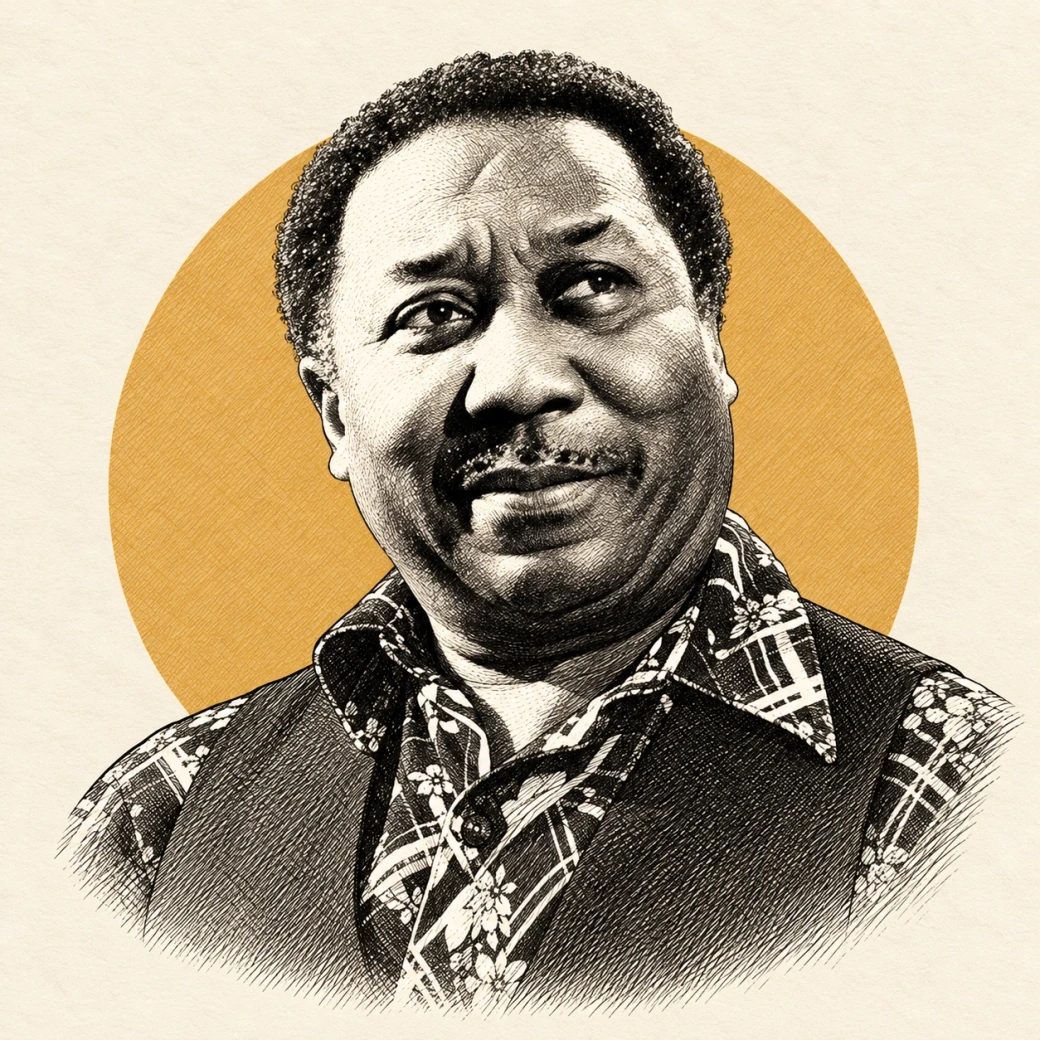
Muddy Waters, born McKinley Morganfield on April 4, 1915, in Rolling Fork, Mississippi, came from a sharecropping family. After his mother's death in 1918 he moved to the Stovall Plantation near Clarksdale to live with his grandmother, who called him Muddy for his love of playing in Deer Creek. He took up harmonica at seven and was playing fish fries and parties by thirteen; at seventeen he bought his first guitar with his sharecropper's wages and taught himself to play. Local musicians including Charley Patton and Son House helped shape the musical world in which he developed.
In August 1941, folklorists Alan Lomax and John Work recorded Waters with fiddler Henry "Son" Sims at Waters's juke joint on the Stovall Plantation, for the Library of Congress. Hearing his own voice on the playback convinced him he had commercial ability. He caught a train to Chicago in May 1943, found a day job and played rent parties before recording for the Aristocrat label, owned by Leonard and Phil Chess, in 1947. His release "I Can't Be Satisfied" sold out several pressings, made him a star and helped lay the foundation of the Chess record label.
Waters's voice and slide guitar became central to his recordings, but his career was also a story of bands. His groups included musicians such as Little Walter, Jimmy Rogers, Otis Spann, James Cotton and Junior Wells, later blues stars who came up in his bands. His Chess catalog grew into a body of standards: "Hoochie Coochie Man," cut in January 1954, and "Mannish Boy," first recorded in 1955, became defining electric blues records. In 1958 he toured England, opening the door for blues musicians to tour Europe and helping inspire the British blues scene that produced the Rolling Stones, a band that took its name from one of his songs. In 1960 his band played the Newport Jazz Festival. He continued recording for Chess, with hits including "Long Distance Call," "Louisiana Blues" and "Honey Bee." Waters died on April 30, 1983, and is buried in Chicago.