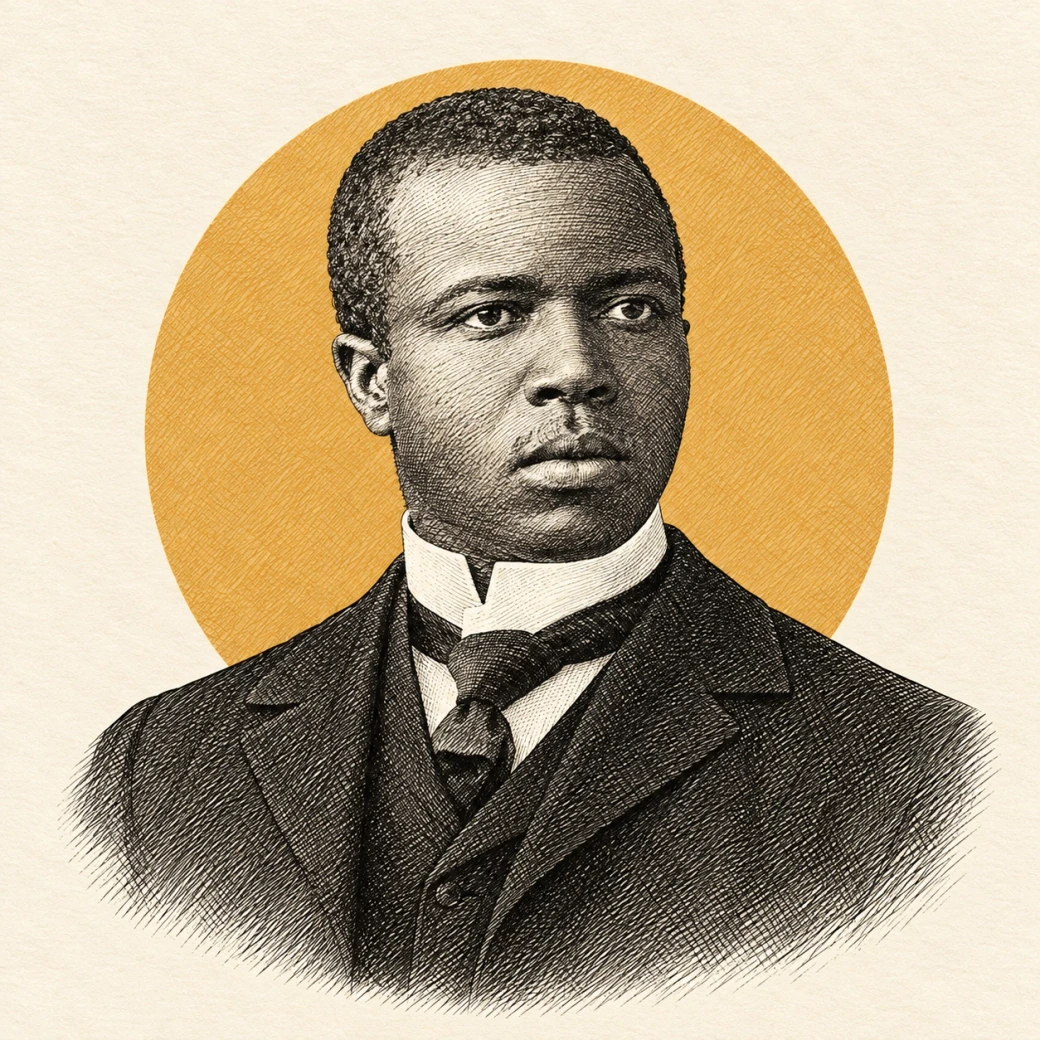
Scott Joplin, called the King of Ragtime, was born about 1867, possibly at Caves Spring near Linden in northeast Texas. His father, Jiles, a laborer and former slave, had some musical ability, and family music-making encouraged the boy, who played banjo at seven and experimented on a neighbor's piano. At about eleven he began free piano lessons from Julius Weiss, a German-born teacher in Texarkana who recognized his talent.
Joplin moved to Sedalia, Missouri, in 1894. In 1899, the publisher Carl Hoffman issued his first ragtime publications, and that August he signed a contract with Sedalia publisher John Stark for "Maple Leaf Rag," named for a local social club. The piece became the greatest instrumental rag of the era: its sheet music went on to sell more than a million copies, and the royalty arrangement gave Joplin a small but steady income from a composition he had written himself, an unusual position for a Black composer in that era.
He entered an on-and-off arrangement with publisher John Stark, and his compositions reached beyond individual rags such as "The Entertainer," "Elite Syncopations" and "Peacherine" to marches, waltzes, ballet and opera. In 1901 he moved to St. Louis, where he continued composing and teaching ragtime students of his own, including Arthur Marshall and Scott Hayden. The School of Ragtime, published in 1908, presented his ideas about playing the music.
His larger works included two operas, The Guest of Honor and Treemonisha, which is considered the first opera written by an African American composer. Joplin held a strong conviction that education was the key to success for African Americans, a recurring theme in his work, and Treemonisha reflected that concern. He settled in New York in 1911 and published the opera's piano-vocal score at his own expense, devoting his energies to the opera, which was mounted unsuccessfully early in 1915. Joplin died on April 1, 1917.
Recognition continued after his death. Treemonisha remained largely unknown until its first complete performance in 1972, and the ragtime revival of the 1970s, fed in part by the film The Sting and its use of "The Entertainer," carried Joplin's piano music back into American ears. In 1976, the Pulitzer organization gave him a posthumous special award for his contributions to American music.