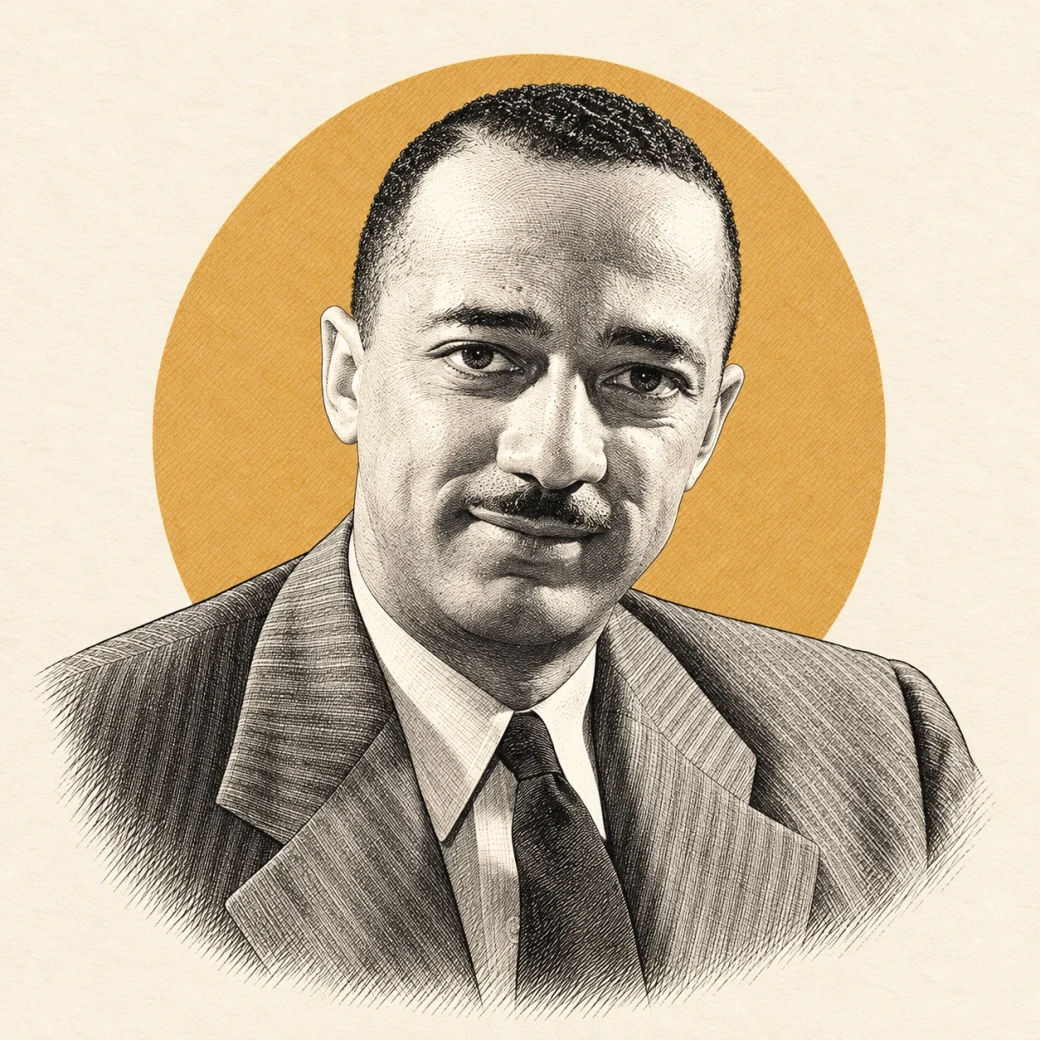
Spottswood W. Robinson III filed Davis v. School Board of Prince Edward County on May 23, 1951, on behalf of the students who had walked out of R.R. Moton High School in Farmville that April, led by sixteen-year-old Barbara Johns. He and fellow lawyer Oliver Hill had been skeptical about challenging segregation itself in a small rural county, but after meeting the students they agreed to take the case, on the condition that the parents backed full desegregation rather than only a better building. The case became one of the five decided together in Brown v. Board of Education, and when the Supreme Court heard it, Marshall asked Robinson to refine the briefs and then to argue the Virginia portion of the case, twice, including as the opening speaker at the December 1953 reargument. Robinson's work belonged to a larger effort by families, legal scholars and NAACP Legal Defense Fund attorneys.
He was born in Richmond on July 26, 1916, into a family whose grandfather had been enslaved in Spotsylvania County and made his way to Richmond's free Black community before emancipation. Robinson left Virginia Union University at eighteen to run his father's real-estate business during an illness, then entered Howard University School of Law in 1936. He graduated in 1939 with an average reputed to be the highest in the school's history and joined its faculty that year.
His Richmond practice with Hill and Martin A. Martin carried a full civil-rights docket. Robinson handled Irene Morgan's interstate-bus case, which produced the Supreme Court's 1946 ruling against segregated seating in interstate travel, and worked with Charles Hamilton Houston on the restrictive-covenant cases that ended judicial enforcement of housing segregation in 1948. At Marshall's urging, he investigated school conditions across Virginia, was involved in about sixty school-equality cases, and pushed the LDF toward its 1950 decision to attack segregation directly rather than seek equalization. He served as the LDF's southeastern regional counsel.
Robinson led Howard's law school as dean from 1960 to 1963 and served on the U.S. Commission on Civil Rights from 1961 to 1963, surviving Senate opposition from Virginia's two senators by a vote of 73 to 17. In 1964, he joined the federal district court in Washington through a recess appointment after Senator James Eastland blocked his nomination. He moved to the D.C. Circuit in 1966 and served as chief judge from 1981 to 1986, only the second African American chief judge of a federal circuit. He took senior status in 1989 and died in Richmond on October 11, 1998. A Richmond federal courthouse was named for him and Judge Robert R. Merhige Jr. in 2008.