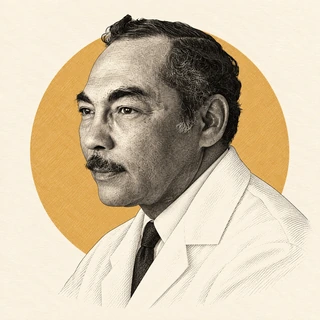
In the middle of the COVID-19 pandemic, Thomas A. LaVeist helped put public-health information where misinformation was spreading. He co-chaired Louisiana's COVID-19 Health Equity Task Force, joined 59 other Black health experts in a New York Times appeal encouraging vaccination, and carried the message through The Skin You're In, a documentary, book and social media campaign he designed to examine why Black Americans live sicker and die younger than other groups in the country.
That campaign grew out of a research career spent on the same question. LaVeist studies how social conditions and public policy shape people's health and their access to care, with particular attention to racial disparities. Born in Brooklyn in 1961, he earned his bachelor's degree in sociology at the University of Maryland Eastern Shore in 1984 and his master's and doctorate in medical sociology at the University of Michigan in 1985 and 1988. He joined the Johns Hopkins Bloomberg School of Public Health as an assistant professor in 1990, became a full professor in 2004, and in 2002 founded the Hopkins Center for Health Disparities Solutions, which he directed until 2016. Between Hopkins and Tulane, he chaired the department of health policy and management at George Washington University. He was elected to what is now the National Academy of Medicine in 2013.
In 2018, Tulane appointed him dean of its School of Public Health and Tropical Medicine, where he holds the Weatherhead Presidential Chair in Health Equity. The school trains the public-health workforce for a state whose residents carry some of the country's heaviest disease burdens, and LaVeist's research points to living conditions and policy choices as forces that shape those outcomes before anyone reaches a clinic.
During the pandemic, the task force he co-chaired and the vaccination appeal he signed put that research to work in Louisiana in real time. He continues to lead the school from New Orleans, with the campaign that carried his research to a national audience still running alongside it.
His books include Minority Populations and Health (2005) and the edited volume Race, Ethnicity and Health (2012). In 2022, the Association of American Medical Colleges gave him its Herbert W. Nickens Award.