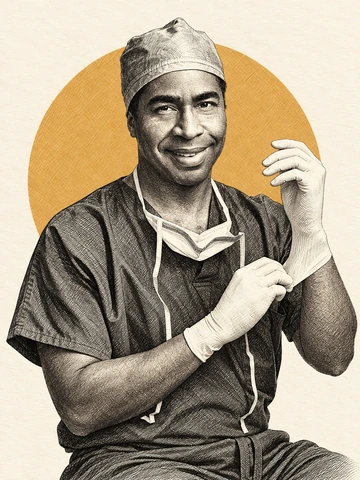
The numbers from one surgical team describe a logistics problem with life-or-death stakes. The Specialized Thoracic Adapted Recovery team, known as STAR and founded and led by Hassan A. Tetteh in Washington, D.C., recovered thoracic organs from 1,118 donors in a study period that began in November 2004, with 24-hour graft survival of 100 percent for lungs and 99 percent for hearts. A donated heart or lung must reach the right patient within hours, and recovery requires a surgical team dedicated to that single task. Tetteh built the STAR model to supply one.
A Brooklyn native born in 1972, Tetteh studied at SUNY Plattsburgh and earned his medical degree at SUNY Downstate. His surgical training took him to the University of Minnesota and Brigham and Women's Hospital, and he later added graduate degrees in public administration, business and national security strategy.
Most of his career ran through the U.S. Navy. From 2003 to 2005, he served as director of surgical services and trauma surgeon aboard the aircraft carrier USS Carl Vinson, and he also worked as a ship surgeon. He became a heart and lung transplant surgeon, served as chief medical informatics officer for the Navy's Bureau of Medicine and Surgery, and held the post of command surgeon at the National Defense University. He retired from the Navy as a captain.
His post-military career joined clinical and executive work. He has served as an associate professor of surgery at the Uniformed Services University of the Health Sciences and as adjunct faculty at Howard University, and Johns Hopkins Carey Business School lists him as a partner and vice president for operations at Vituity and as a thoracic surgeon for Inova Health and Howard University Hospital.
He teaches and writes on the human side of that work as well. He is the creator of The Art of Human Care book series, which approaches medicine through the experience of the people receiving it. The recovery teams he built in Washington set out to solve one problem, getting hearts and lungs from donors to waiting patients, and the published results describe a model that did it reliably.