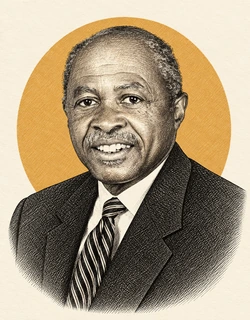
Otis Frank Boykin was an African American engineer and inventor who lived from 1920 to 1982. Born in Dallas, he graduated as valedictorian from Booker T. Washington High School in 1938 and earned a scholarship to Fisk University, where he studied physics and chemistry. After graduating in 1941, he moved to Chicago and worked as a laboratory assistant at Majestic Radio and TV Corporation, testing automatic pilot control units used in airplanes during World War II.
He enrolled at the Illinois Institute of Technology in 1946 but had to leave in 1947 because he could no longer afford tuition. He turned to his own inventions, focusing on resistors, the components that control the flow of current in a circuit. His first patent, in 1959, covered a wire precision resistor that produced an exact amount of resistance, customizable to a specific purpose. A 1961 patent covered a resistor that could withstand extreme changes in temperature and pressure. His designs were more affordable and more reliable than earlier models, and buyers included the U.S. military, IBM and other technology organizations.
At CTS, his work on a ceramic-and-metal resistive element contributed to an adjustable pacemaker component developed in cooperation with Wilson Greatbatch. The National Inventors Hall of Fame records that his work contributed to the first successful implantable pacemaker, and in 1964 he developed a control unit for the devices, which deliver steady electrical pulses to regulate irregular heartbeats. His resistor work made pacemakers more efficient, longer lasting and less expensive to manufacture.
After leaving CTS in 1964, Boykin continued as a consultant in the United States and France until his death in 1982, working on electronic resistors throughout. He earned more than 25 U.S. patents, including an electrical capacitor in 1965, a resistance capacitor in 1967, a burglar-proof cash register and a chemical air filter. His engineering contributions earned posthumous induction into the National Inventors Hall of Fame in 2014.
Resistors are among the most common components in electronics, which is why improvements in their precision and durability spread through whole industries rather than single products.